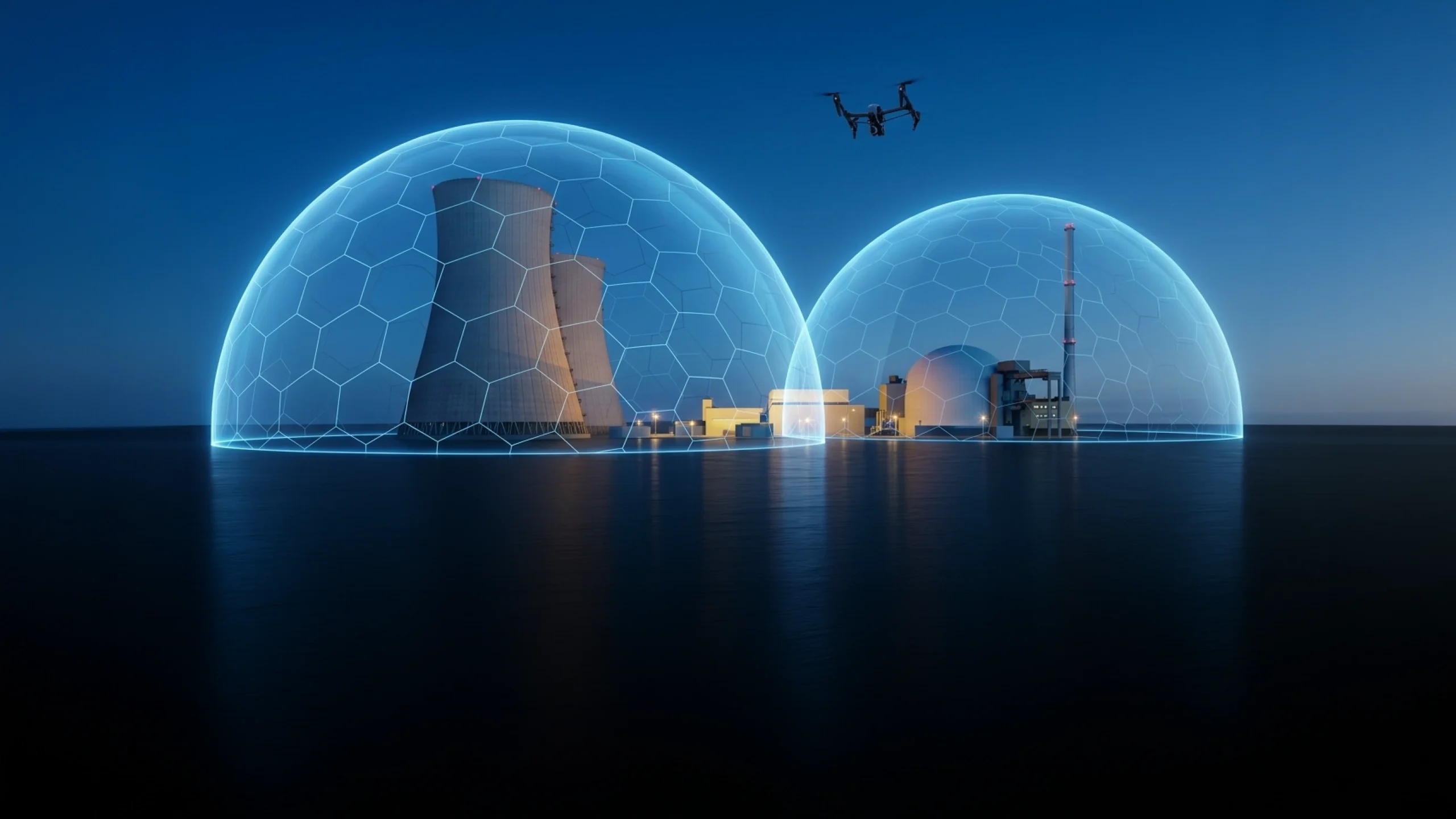
Security Dome
Counter-UAS Framework for Critical Infrastructure Protection
A Ukrainian-developed counter-UAS framework combining drone defence, cybersecurity and physical security into a unified infrastructure resilience architecture for European critical infrastructure operators — helping you assess vulnerabilities, strengthen resilience and coordinate multi-domain security across physical, digital and airspace domains.
Why critical infrastructure security requires a counter-UAS approach
UAV-related incidents are no longer a distant geopolitical concern. Drone incursions represent an immediate operational risk affecting business continuity, service availability and asset integrity across Europe's most vital sectors — making counter-UAV protection a core element of modern critical infrastructure security.
Airports & Aviation
Drone incursions into controlled airspace have triggered runway closures and operational suspensions at major European airports, causing cascading disruptions to regional transport networks. Counter-UAS protection has become essential for aviation continuity.
Energy Facilities & Utilities
Power generation and transmission infrastructure faces growing exposure to UAV reconnaissance and disruption attempts. Extended outage scenarios pose significant economic and social consequences, making drone defence a critical component of energy infrastructure resilience.
Logistics Hubs & Supply Chain
Distribution centers, port facilities and intermodal hubs represent high-value targets where operational disruption ripples across interconnected supply chains serving broad economic regions.
Industrial Facilities
Manufacturing plants and process industry sites combine high asset concentration with complex operational environments that create significant vulnerability exposure requiring structured risk assessment.
* Figures shown as indicative format. Final statistics to be confirmed with verified sources prior to publication.
Counter-UAS experience developed under real conditions
Ukraine has operated under continuous infrastructure exposure to aerial threats since 2022 — accumulating operational knowledge in counter-UAV protection, drone defence and infrastructure resilience that simply does not exist in conventional commercial security markets.
This is not theoretical security planning. It is the structured outcome of protecting real facilities, under real pressure, with real consequences for failure. We translate that experience into frameworks your organization can apply today.
Operational Expertise
Validated protection methodologies developed through continuous multi-domain security operations across diverse infrastructure typologies.
Resilience Lessons
Documented understanding of how infrastructure behaves under pressure, where vulnerabilities emerge and how organizations maintain continuity under sustained threat exposure.
Drone Risk Assessment
Structured drone risk assessment frameworks for multi-domain vulnerability mapping — covering physical perimeters, digital systems and airspace exposure simultaneously.
Transferable Methodology
Protection approaches designed to be adapted to European regulatory environments, governance requirements and existing security architectures.
An integrated counter-UAS & multi-domain security framework
Security Dome is not a product. It is an integrated counter-UAS framework combining four interconnected security domains — conventional security, physical protection, digital shield and airspace protection — into a unified multi-domain security architecture, so operators can address vulnerability holistically rather than through isolated point solutions.
Conventional Security
- Access control systems
- CCTV and video surveillance
- Centralized monitoring
- Fire and emergency protection
- Facility power resilience
Physical Protection
- Perimeter security
- Personnel protection
- Rapid response capability
- Access governance
- Critical zone safeguarding
Digital Shield
- Cybersecurity architecture
- Network and OT protection
- Communication security
- Business continuity systems
- Control system hardening
Counter-UAS & Airspace Protection
- UAV and drone threat detection
- C-UAS classification and identification
- Counter drone technology integration
- Response coordination
- Regulatory-compliant countermeasures
From assessment to implementation
A structured engagement designed to deliver clarity, prioritization and actionable protection strategy — not generic recommendations.
Risk Assessment
On-site evaluation, vulnerability mapping and multi-domain risk analysis across physical, digital and airspace dimensions.
Expert Report
Documented findings, prioritized threat scenarios and identified vulnerabilities presented to your leadership team.
Protection Strategy
Customized implementation roadmap tailored to your operational context, regulatory environment and risk tolerance.
Implementation
Deployment of selected protection measures, procedures and monitoring capabilities with ongoing operational support.
Layered airspace awareness and protection
Effective aerial risk management requires multiple coordinated layers working in sequence — not a single technology or point solution.
Detection
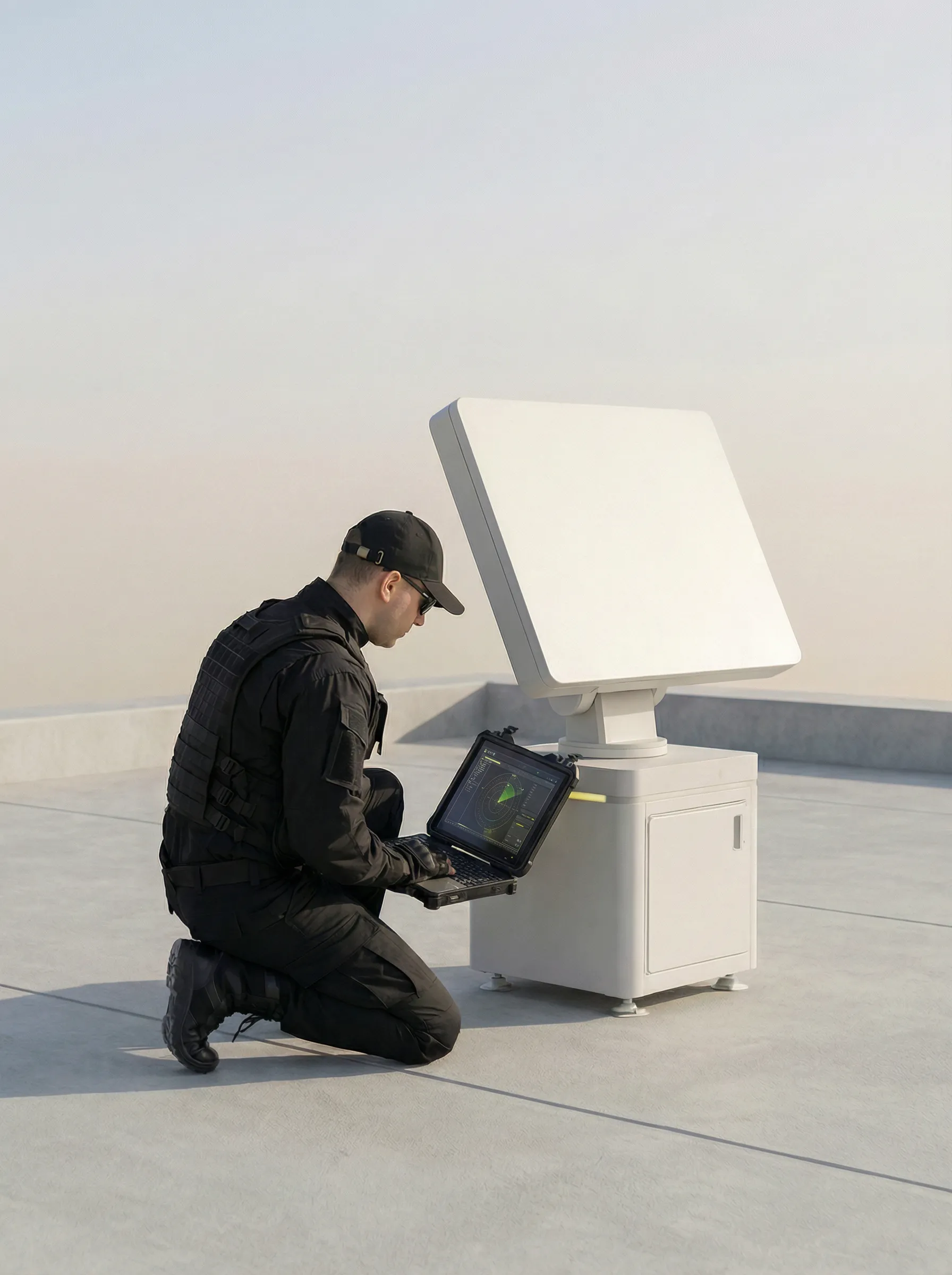
Early identification of potential aerial threats through multiple complementary sensor technologies, providing advance warning and situational awareness before threats approach sensitive areas.
Electronic Protection
Legally compliant electronic countermeasures where permitted under applicable national and EU regulations. All electronic measures are implemented in strict accordance with local frequency and spectrum governance frameworks.
Response Coordination
Structured response procedures integrated into broader facility security operations — ensuring coordinated action across all protection domains when aerial threats are identified and confirmed.
Human-in-the-Loop Principle
Every active response within the Security Dome framework requires explicit human confirmation, operational oversight and documented authorization. This is not a design option — it is a governance requirement embedded in every deployment. No automated action proceeds without accountable human decision-making.
One operational picture
All counter-UAS and security domains integrated into a single unified multi-domain security environment — giving decision-makers complete situational awareness at every moment.
Centralized Monitoring
All security systems and protection layers visualized on a unified digital facility map in real time.
Remote and Local Operation
Flexible operational control supporting both on-site command teams and remote oversight from authorized locations.
Real-Time Situational Awareness
Continuous integration of data across all protection domains, enabling informed decision-making under any operational condition.
Interoperability
Designed to integrate with existing security infrastructure, avoiding replacement of functional systems and protecting prior investments.
Built on transparency
We show what is established and what is still being validated — clearly separated, with nothing overstated.
We believe infrastructure resilience should be supported by measurable evidence rather than unverified claims. Where data is not yet available, we say so — and commit to providing it as our validation processes mature.
Partnership options
Every engagement begins where your organization is — with a structured conversation, not a sales presentation.
Closed Briefing
An executive-level introduction to the Security Dome methodology, framework architecture and the operational experience underpinning it. Delivered in a confidential format tailored to your organization's context and priorities.
Request a BriefingDemonstration Pilot
A structured joint implementation and evaluation program conducted at a selected facility. Provides your team with first-hand assessment of the framework's applicability and operational value in your specific environment.
Explore a PilotTechnical Collaboration
For technology companies, security integrators and counter-UAS ecosystem participants interested in interoperability, technology integration, joint development or strategic partnership within the Security Dome framework.
Discuss CollaborationWhy organizations choose to engage
Ukrainian Operational Experience
Practical resilience knowledge developed under real infrastructure exposure that no theoretical framework can replicate.
Integrated Security Approach
Four domains addressed simultaneously — no organizational gaps left between physical, digital, conventional and airspace protection.
Human-in-the-Loop Governance
Every active response requires human authorization — ensuring accountability, regulatory compliance and responsible operation.
Infrastructure Resilience Focus
The objective is operational continuity and risk reduction — not security theater or technology-driven complexity.
Multi-Domain Security Expertise
Counter-UAS engineering, cybersecurity, physical security and airspace management working as an integrated team, not separate vendors.
Partnership-Driven Methodology
Engagements are structured around your context, regulatory environment and organizational objectives — not standardized product deployments.
Ready to discuss your counter-UAS & resilience requirements?
If your organization is evaluating counter-UAS readiness, drone defence, critical infrastructure protection or integrated multi-domain security frameworks, SHERIFF is ready to provide a structured briefing and explore potential collaboration opportunities.
Common questions
Request a briefing or inquiry
Fill in the form and our team will respond within one business day.
By submitting this form you agree to our Privacy Policy. Your information will be used solely to respond to your inquiry and will not be shared with third parties without your consent.