
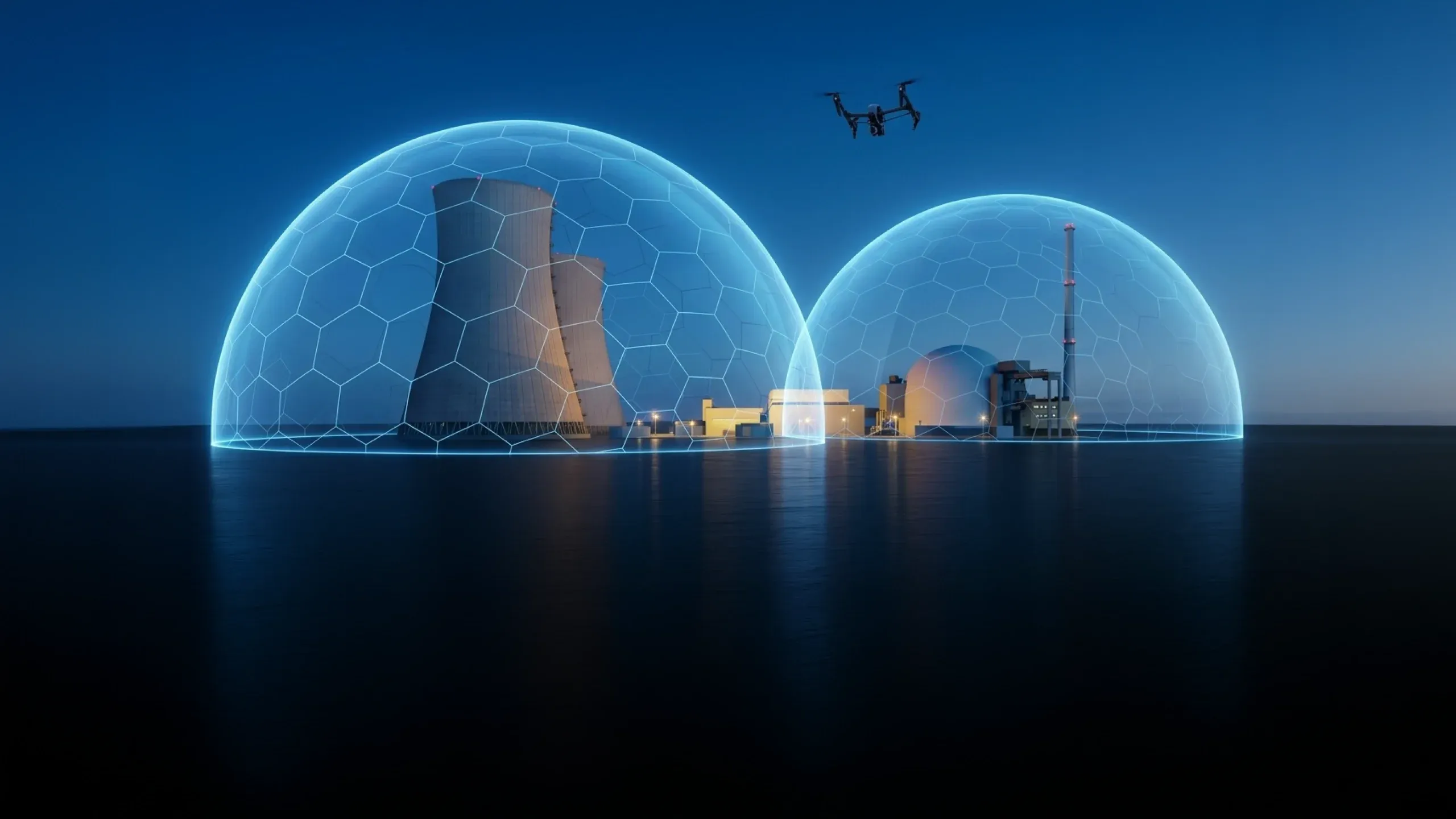
Security Dome
Counter-drone defence & protection of critical infrastructure
A framework developed in Ukraine that unites counter-drone defence, cybersecurity and physical protection in an integrated security architecture for KRITIS operators in the DACH region. It helps operators of critical infrastructure identify vulnerabilities, integrate drone detection and airspace monitoring into existing security architectures, and develop coordinated protection concepts across the physical, digital and airspace domains.
Why KRITIS operators need counter-drone defence as an integrated protection concept
Drone attacks and unauthorised drone incursions are no longer a distant geopolitical concern. They represent an immediate operational risk to critical infrastructure - and with the KRITIS Regulation and the new KRITIS Umbrella Act, protecting critical infrastructure becomes a regulatory obligation.
Airports & aviation
Drone incursions into controlled airspace have triggered runway closures and operational disruption at major European airports. Effective counter-drone defence and airspace monitoring are now a prerequisite for operational continuity in aviation.
Energy facilities & utilities
Power generation and transmission infrastructure is increasingly exposed to drone attacks and reconnaissance attempts. Extended outage scenarios have significant economic and societal consequences - which makes counter-drone defence a central component of energy infrastructure security.
Logistics hubs & supply chains
Distribution centres, port facilities and intermodal transfer points are high-value targets whose disruption propagates widely across entire economic regions through interconnected supply chains.
Industrial facilities
Production plants and process industry sites combine a high concentration of assets with complex operating environments that create considerable attack surfaces and call for structured risk assessments.
Counter-drone experience from real conditions
Since 2022 Ukraine has been operating under a continuous drone threat to critical infrastructure - accumulating operational knowledge of counter-drone defence, drone detection and KRITIS protection that simply does not exist in conventional commercial security markets.
This is not theoretical security planning. It is the structured result of protecting real facilities, under real pressure, with real consequences in the event of failure. We translate that experience into frameworks your organisation can apply today.
Operational expertise
Validated protection methodologies developed through continuous, cross-domain security operations across diverse types of infrastructure.
Counter-drone insights
A documented understanding of how critical infrastructure behaves under a sustained drone threat, where vulnerabilities emerge and how operators maintain operational continuity despite drone attacks.
Drone detection & risk analysis
A structured methodology for drone detection and cross-domain vulnerability mapping - capturing physical perimeters, digital systems and airspace monitoring simultaneously. The foundation of any effective counter-drone concept.
Transferable methodology
Protection approaches that can be adapted to European regulatory environments, governance requirements and existing security architectures.
An integrated framework for counter-drone defence & KRITIS protection
Security Dome is not a product. It is an integrated framework that brings four interconnected security domains - conventional security, physical protection, digital protection and counter-drone defence - together into a single security architecture. It allows KRITIS operators to address the protection of critical infrastructure holistically instead of relying on isolated point solutions.
Conventional security
- Access control systems
- CCTV and video surveillance
- Centralised monitoring
- Fire and emergency protection
- Power supply resilience of the facility
Physical protection
- Perimeter security
- Close protection
- Rapid response capability
- Access governance
- Protection of critical zones
Digital shield
- Cybersecurity architecture
- Network and OT protection
- Communications security
- Business continuity systems
- Hardening of control systems
Counter-drone defence & airspace monitoring
- Drone detection and sensors
- Classification and identification of UAVs
- Integration of counter-drone systems
- Coordinated countermeasures
- Regulatory-compliant response
From assessment to implementation
A structured process that delivers clarity, prioritisation and an actionable protection strategy - not generic recommendations.
Risk assessment
On-site assessment, vulnerability mapping and cross-domain risk analysis across the physical, digital and airspace dimensions.
Expert report
Documented findings, prioritised threat scenarios and identified vulnerabilities - prepared for your executive level.
Protection strategy
A tailored implementation roadmap aligned with your operational context, your regulatory environment and your risk appetite.
Implementation
Rollout of selected protective measures, procedures and monitoring capabilities with ongoing operational support.
Multi-layered situational awareness and airspace protection
Effective airspace risk management requires several coordinated layers of protection working together - not a single technology or point solution.
Detection
Early identification of potential air threats through multiple complementary sensor technologies - advance warning and situational awareness before threats reach sensitive areas.
Electronic protection
Legally compliant electronic countermeasures, insofar as they are permitted under applicable national and EU regulations. All electronic measures are implemented in strict accordance with local frequency and spectrum governance frameworks.
Coordination of countermeasures
Structured response procedures embedded in the facility's wider security operations - coordinated action across all protection domains when air threats are identified and confirmed.
Human-in-the-loop principle
Every active response within the Security Dome framework requires explicit human confirmation, operational oversight and documented authorisation. This is not a design option - it is a governance requirement anchored in every implementation. No automated measure is taken without a responsible human decision.
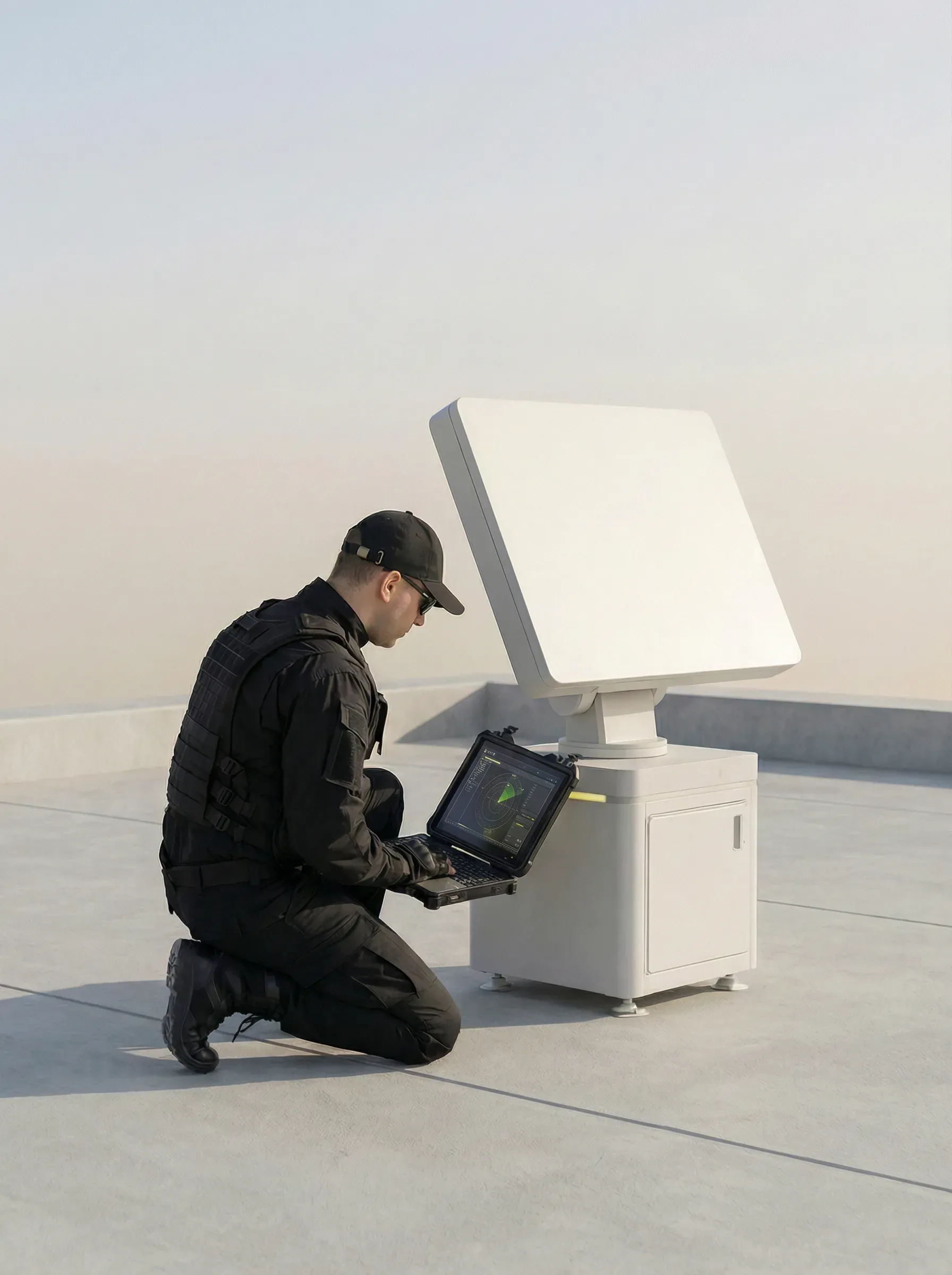
A single operational picture
All protection domains - counter-drone defence, cybersecurity, physical protection - brought together in one security architecture. Decision-makers retain full situational awareness at all times.
Centralised monitoring
All security systems and protection layers visualised in real time on a single digital site map.
Remote and local operation
Flexible operational control for local command teams on site and remote monitoring from authorised locations.
Real-time situational awareness
Continuous data integration across all protection domains - informed decision-making under any operational condition.
Interoperability
Designed to integrate into existing security infrastructure - without replacing functioning systems, protecting investments already made.
Built on transparency
- Protection methodology
- Four-domain security architecture
- Governance framework
- Human-in-the-loop operating model
- Cross-domain risk assessment process
- Operational performance metrics
- Response efficiency benchmarks
- Measurement of economic impact
- ROI and return-on-investment data
- Third-party effectiveness validation
We believe infrastructure resilience should be supported by measurable evidence - not by unverified claims. Where data is not yet available, we say so openly and commit to providing it as our validation processes mature.
Partnership options
Every collaboration starts where your organisation stands - with a structured conversation, not a sales presentation.
Closed briefing
An executive-level introduction to the Security Dome methodology, the framework architecture and the operational experience both are built on. Prepared confidentially and tailored to your organisation's context and priorities.
Request a briefingDemonstration pilot
A structured joint implementation and evaluation programme at a selected facility. Your team gains a first-hand assessment of the framework's applicability and operational value in your specific environment.
Explore a pilotTechnical collaboration
For technology companies, security integrators and players in the counter-UAS ecosystem interested in interoperability, technology integration, joint development or strategic partnership within the Security Dome framework.
Discuss collaborationWhy organisations choose to work with us
Ukrainian operational experience
Practical resilience knowledge gained under real infrastructure exposure - no theoretical framework can replicate it.
Integrated security approach
Four domains addressed simultaneously - no organisational gaps between physical, digital, conventional and airspace protection.
Human-in-the-loop governance
Every active response requires human authorisation - for accountability, regulatory conformity and responsible operation.
Focus on KRITIS protection and operational continuity
The goal is operational continuity and risk reduction for KRITIS operators - not security theatre or technology-driven complexity.
Cross-domain counter-drone expertise
Counter-drone engineering, cybersecurity, physical security and airspace monitoring work as one integrated team - not as separate vendors.
Partnership-oriented methodology
Engagements are aligned with your context, your regulatory environment and your organisational goals - not standardised product rollouts.
Common questions
What is counter-drone defence and what does protection against drone attacks involve?
Counter-drone defence means the integrated detection, identification and neutralisation of unauthorised drones. Effective counter-drone defence is not a single device but a multi-layered architecture of sensors, drone detection, classification logic and regulatory-compliant response capabilities.
What is KRITIS and who counts as a KRITIS operator?
KRITIS stands for critical infrastructure - facilities of major importance to the functioning of the state and society. KRITIS operators are companies in the energy, water, food, IT/telecommunications, health, finance, transport and public administration sectors, provided they exceed defined thresholds.
What is the KRITIS Umbrella Act and what does it mean for counter-drone defence?
The KRITIS Umbrella Act extends the regulatory requirements for the physical protection of critical infrastructure in Germany and also addresses physical threats, including drone attacks. KRITIS operators must implement, document and demonstrate appropriate protective measures.
What is Security Dome and how does it differ from conventional security services?
Security Dome is an integrated framework for counter-drone defence and the protection of critical infrastructure that unites four security domains - conventional security, physical protection, cybersecurity and counter-drone defence - in a single security architecture.
Ready to discuss your counter-drone and KRITIS protection requirements?
If your organisation is evaluating counter-drone defence, drone detection, the protection of critical infrastructure or an integrated security architecture, SHERIFF is ready to deliver a structured briefing and explore potential ways to collaborate.